
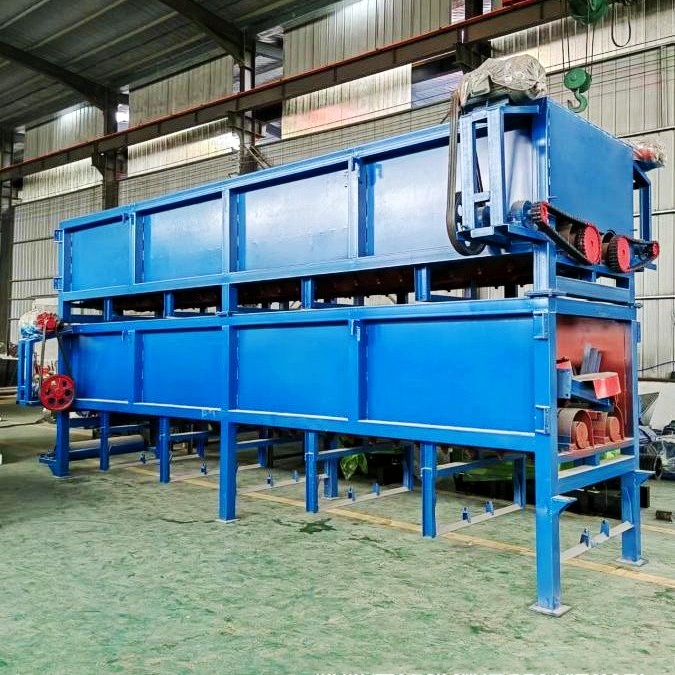
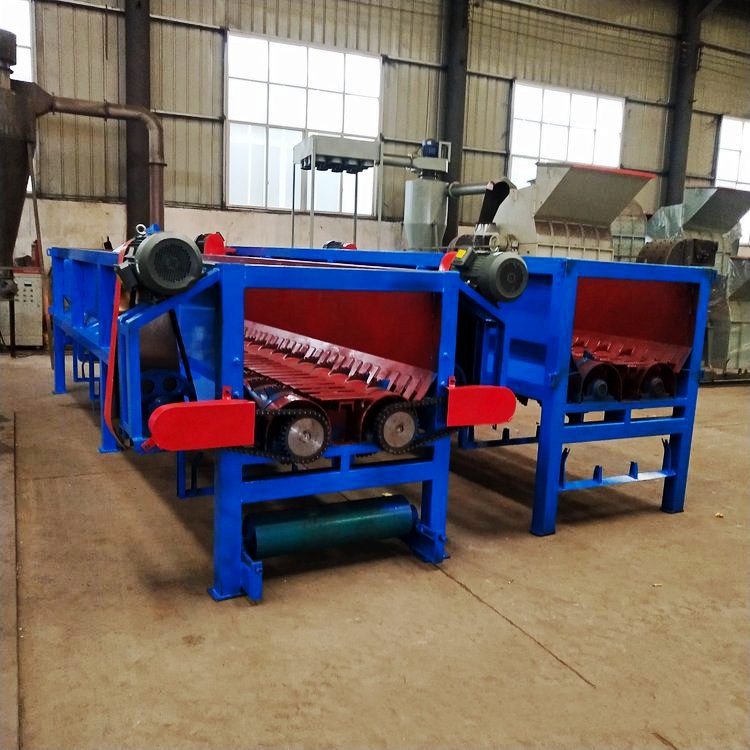
Double-Roller Wood Debarker Product Introduction
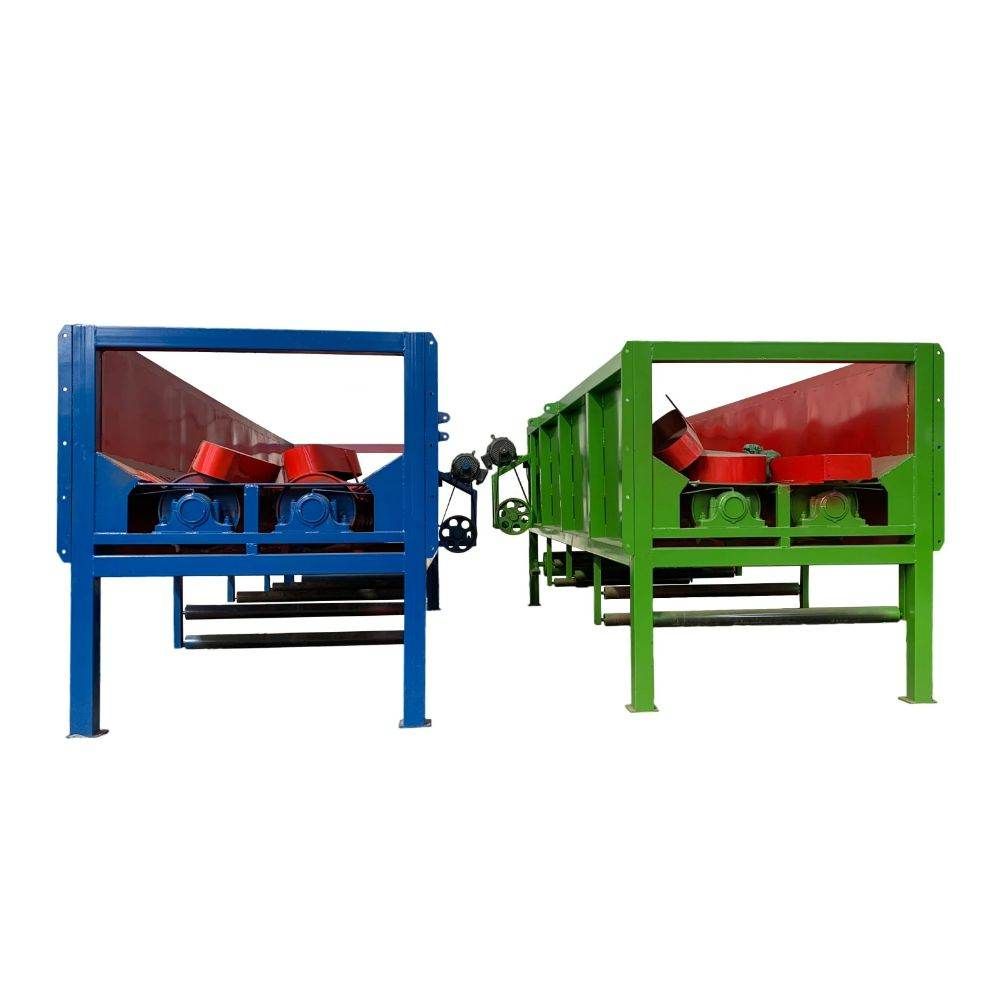
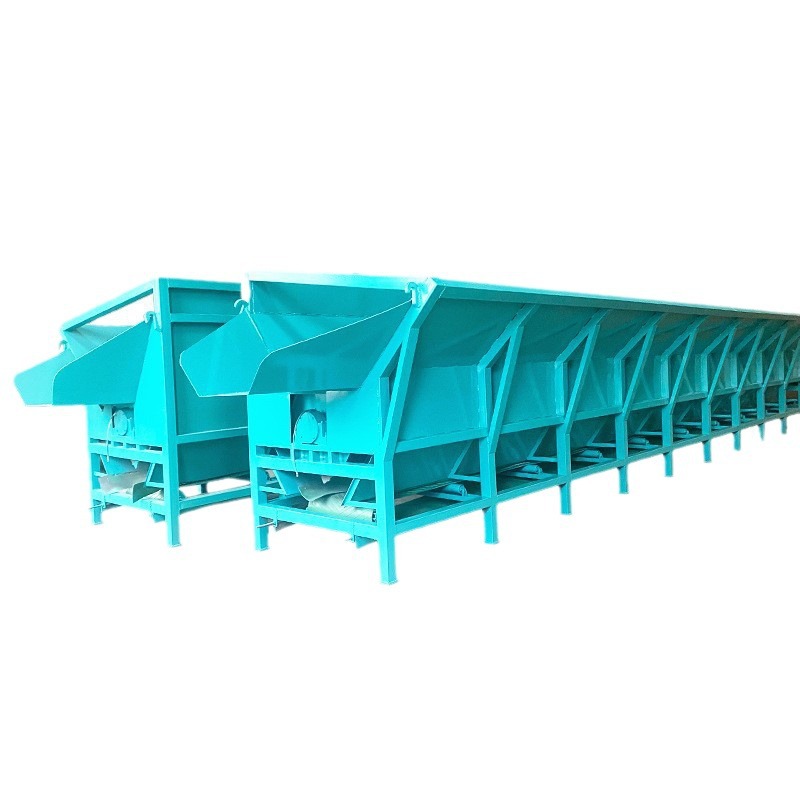
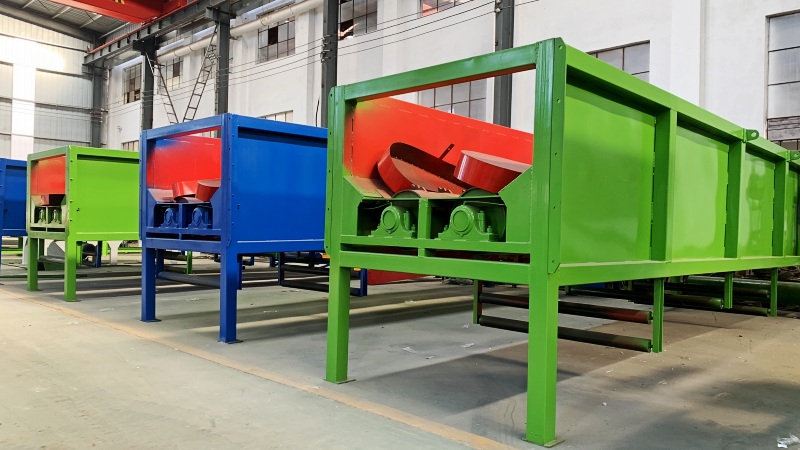
The Double-Roller Wood Debarker (also known as Double-Rotor Wood Debarker or Trough-Type Double-Roller Wood Debarker) is a high-efficiency mechanical product designed for wood processing. Its core structure comprises double rollers, a feed inlet, a discharge outlet, and a power transmission system. Featuring an open silo design, it supports continuous loading and unloading in assembly line operations, making it suitable for medium-density fiberboard (MDF) factories, paper mills, wood chip mills, and other relevant scenarios.
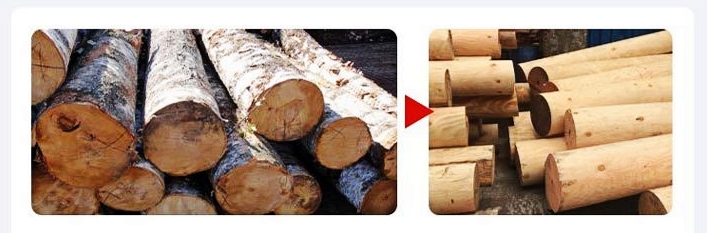
Driven by the impact force of teeth on the high-speed rotating double rollers, the wood logs move circularly and rotate on their own axes. Bark removal is achieved through the combined effects of friction and collision. The machine can process curved wood logs with a diameter of 20–500mm and a length of ≤12 meters, as well as hard-to-peel tree species such as eucalyptus and poplar, with a peeling cleanliness rate of over 95%. Its hydraulic control system and stepless speed-regulating feeding mechanism are adaptable to different wood characteristics. Equipped with four-edged cutters and an automatic bark conveying device, a single unit can process 35–50 tons of wood per day, with lower energy consumption and fewer failures compared to traditional drum-type debarkers.
Product Features
Key features of the Double-Roller Wood Debarker:
1. Adopts a roller-type peeling structure, which is simple, robust, and high in rigidity, ensuring low failure rate and long service life.
2. Consists of five components: peeling rollers, feed inlet, bark outlet, wood outlet, and power transmission device. It eliminates the drawback of traditional drum-type wood debarkers that require shutdown for both feeding and discharging.
3. The open silo enables assembly line operation with feeding from one end and discharging from the other, overcoming the limitations of existing drum-type debarkers that rely on power interruption for feeding/discharging and operate in segments, thus achieving high work efficiency.
4. The impact of the teeth on the wood logs not only drives the logs to move circularly inside the machine housing but also rotate on their own axes, resulting in high peeling efficiency. It delivers excellent peeling results for hard-to-peel species like eucalyptus and poplar, with a cleanliness rate exceeding 95%.
5. High adaptability to wood: capable of peeling logs of different species, diameters, lengths, and shapes. Due to the rotational and irregular jumping movement of the logs, the concave parts of curved logs can make full contact with the peeling teeth. Therefore, the peeling cleanliness rate for curved logs is significantly higher than that of other drum-type debarkers.
6. The large machine housing is fixed, leading to low energy consumption, few failures, minimal maintenance workload, and much lower vibration and noise compared to drum-type debarkers. The machine can start production immediately after being placed on the ground, even without base installation, ensuring convenient use.
Open Silo
Enables assembly line operation with feeding from one end and discharging from the other. It overcomes the drawbacks of traditional drum-type debarkers that require power interruption for feeding/discharging and operate in segments, thus ensuring high work efficiency.
High Adaptability
Capable of peeling logs of different species, diameters, lengths, and shapes. Due to the rotational and irregular jumping movement of the logs, the concave parts of curved logs can make full contact with the peeling teeth.
Fixed Machine Housing
Features low energy consumption, few failures, and minimal maintenance workload. Its vibration and noise levels are much lower than those of drum-type debarkers. The machine can start production immediately after being placed on the ground, even without base installation, offering convenient operation.
Working Principle
Load logs, branches, and other wood materials into the roller, close the feed baffle, start the machine, and operate it clockwise. As the machine runs, the wood inside the roller is peeled by the cutters. After 15 minutes, stop the machine, open the discharge baffle, restart the machine, and operate it counterclockwise for 2 minutes. The peeled wood will then be automatically discharged from the roller. The peeling cleanliness rate can reach 95%.
Scope of Application: Suitable for peeling newly felled coniferous wood and some broad-leaved wood, and can also handle the peeling of some frozen wood and dry wood.
The wood debarker produced by our factory is equipped with eight-edged cutters, boasting high peeling efficiency, long service life, and low cost. Adopting stepless speed regulation technology, it automatically adjusts the feeding speed and is suitable for peeling various types of wood with different species, diameters, and curvatures. This series of products offers excellent peeling quality and high production efficiency, with technical performance reaching the advanced domestic level.
Operation Requirements
Basic operation guidelines for multi-scenario wood processing:
– To fully exert the machine’s performance, at least 2 operators are required.
– The materials to be processed must not contain impurities such as iron and stones.
– During operation, properly adjust the feeding volume. Excessive feeding may cause overload and stalling, while insufficient feeding will affect cutting efficiency.
– In case of material blockage during operation, do not forcibly feed materials by hand or iron rod; stop the machine immediately to clear the blockage.
– If any abnormality is found or abnormal noise is heard during operation, stop the machine immediately for inspection. The power supply must be cut off before inspection; troubleshooting is prohibited while the machine is running.
– Apply butter to all moving parts once a day, and add lithium-based grease to the main bearing every 300 hours of operation.
– When stopping work, let the machine run idle for 2 minutes to blow off dust and weeds inside the machine, then shut down the machine.
Double Roller Wood Debarker – Technical Specifications
| Parameter | Unit | DR-6000 (6m) |
DR-9000 (9m) |
DR-12000 (12m) |
DR-S500 (Small) |
DR-S800 (Medium) |
|---|---|---|---|---|---|---|
| Basic Specifications | ||||||
| Model | – | DR-6000 | DR-9000 | DR-12000 | DR-S500 | DR-S800 |
| Roller Structure | – | Double Roller U-type Slot |
Double Roller U-type Slot |
Double Roller U-type Slot |
Double Roller Compact |
Double Roller Heavy-duty |
| Total Length | mm | 6,300 | 9,300 | 12,300 | 5,800 | 6,500 |
| Roller Diameter | mm | 530 | 530 | 530 | 250 | 320 |
| Roller Length | mm | 5,000 | 8,000 | 11,000 | 500 | 800 |
| Processing Capacity | ||||||
| Wood Diameter Range | mm | 200-600 | 200-600 | 200-600 | 50-200 | 50-300 |
| Wood Length Range | m | 0.5-2 | 0.5-2.5 | 0.5-3 | 2-4 | 2-5 |
| Production Capacity | t/h | 7-15 | 12-20 | 20-25 | 5-6 | 8-10 |
| Performance Metrics | ||||||
| Debarking Rate | % | Fresh Log: >95 Dry Log: >90 |
Fresh Log: >95 Dry Log: >90 |
Fresh Log: >95 Dry Log: >90 |
Fresh Log: >95 Dry Log: >90 |
Fresh Log: >95 Dry Log: >90 |
| Timber Loss Rate | % | <2 | <2 | <2 | <1.5 | <1.5 |
| Roller Rotational Speed | rpm | 200 | 180 | 160 | 230 | 200 |
| Power Requirements | ||||||
| Main Motor Power | kW | 7.5×2 | 11×2 | 15×2 | 5.5×2 | 7.5×2 |
| Hydraulic System Power | kW | 2.2 | 3 | 4 | – | 2.2 |
| Total Installed Power | kW | 17.2 | 25 | 34 | 11 | 17.2 |
| Voltage/Frequency | V/Hz | 380/50 (Customizable) |
380/50 (Customizable) |
380/50 (Customizable) |
380/50 (Customizable) |
380/50 (Customizable) |
| Physical Dimensions | ||||||
| Overall Width | mm | 1,500 | 1,550 | 1,600 | 1,300 | 1,450 |
| Overall Height | mm | 1,700 | 1,750 | 1,800 | 1,500 | 1,650 |
| Net Weight | t | 5 | 8 | 12 | 2.5 | 4 |
| Special Features | ||||||
| Opening System | – | Manual/Hydraulic | Hydraulic | Hydraulic | Manual | Hydraulic |
| Tooth Material | – | High Manganese Steel | High Manganese Steel | High Manganese Steel | Alloy Steel | High Manganese Steel |
| Material Handling | – | Excavator/Loader Feeding |
Excavator/Loader Feeding |
Excavator/Loader Feeding |
Manual/Conveyor | Conveyor/Loader |
| Bark Discharge | – | Belt Conveyor | Belt Conveyor | Belt Conveyor | Gravity Chute | Belt Conveyor |
| Application Scope | ||||||
| Suitable Wood Types | – | Pine, Eucalyptus, Birch, Hardwood |
Pine, Eucalyptus, Birch, Hardwood |
Pine, Eucalyptus, Birch, Hardwood |
Small Logs, Branches |
Medium Logs, Processing Plants |
| Ideal Industries | – | Sawmills, Paper Mills, Wood Chip Plants |
Sawmills, Paper Mills, Biomass Power Plants |
Large-scale Wood Processing Centers |
Furniture Factories, Small Workshops |
Medium-sized Sawmills, Wood Pellet Plants |
Key Features & Advantages
- High Debarking Efficiency: Utilizes dual-roller rotation and friction to achieve >95% debarking rate for fresh logs and >90% for dry logs
- Minimal Timber Loss: Advanced tooth design ensures less than 2% wood loss during processing
- Durable Construction: Rollers made of high manganese steel for extended service life (≥5 years)
- Versatile Processing: Handles various wood types including pine, eucalyptus, birch, and hardwoods
- Easy Operation: Fully automatic feeding and discharging, requiring only 1-2 operators
- Low Maintenance: Simple structure with easy access to components for quick repairs
Installation & Operation Requirements
- Foundation: Concrete foundation with 200mm thickness, reinforced with steel bars
- Power Supply: 3-phase AC power, 380V/50Hz (customizable for 415V/60Hz)
- Space Requirement: DR-6000: 8m×3m×2m; DR-12000: 14m×3.5m×2.5m
- Environmental Conditions: Temperature: -10°C to 45°C; Humidity: ≤90% (non-condensing)
- Safety Features: Emergency stop buttons, safety guards, overload protection